Webinar Promotion: A B2B Partner Plan Beyond Your Own List
Build a B2B webinar promotion plan with audience-fit partners, a clear invitation brief and an agreed exchange. Includes fictional copy and a review checklist.
By Lead Scorer 8 min read
A webinar promotion plan should explain who the session helps, why it is worth attending and how relevant people outside your existing list will hear about it. For a small B2B team, that can mean a carefully chosen partner and a clear invitation brief before additional paid distribution. Start with audience fit and an agreed exchange, then measure the registrations and conversations you can actually observe.
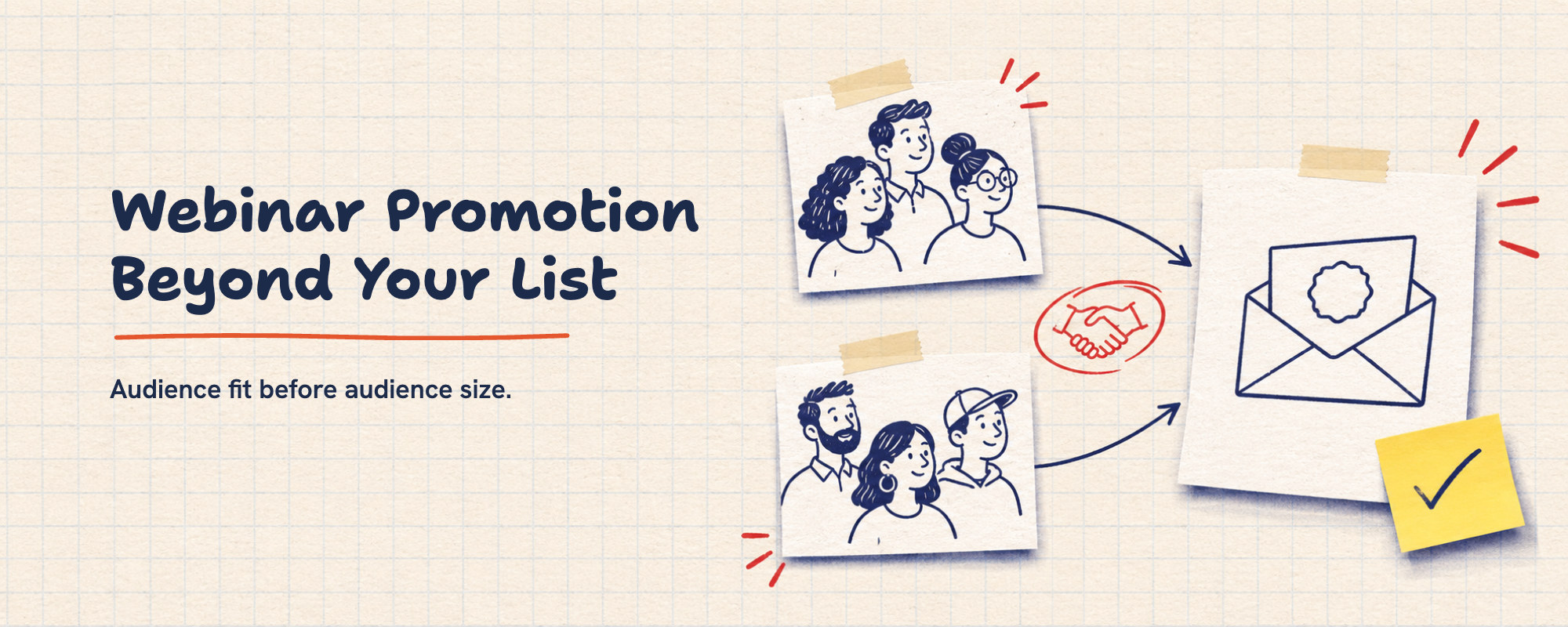
The podcast lesson: reach another relevant audience
In Exit Five's conversation with Logan Lyles, the DemandShift founder identifies promoting only to an existing list as one webinar mistake. He describes reciprocal newsletter promotion and explains how an exchange can include different contributions when subscriber counts are unequal.
That is a practitioner's account, not a controlled comparison of channels. His discussion of email performance does not establish a universal benchmark for your audience. The planning sheet, example messages and review process below are editorial proposals. They do not reproduce a tested framework supplied by the guest.
The useful distinction is between announcing the event again to the same people and giving a different, relevant audience a reason to consider it. A larger list is not automatically a better partner. Nor does a registration establish buying intent.
1. Write the attendee promise before choosing partners
Choose one job the intended attendee is trying to do. Name the role, the situation and what the session will help that person work through. “The future of operations” is a broad topic. “How operations managers can review a recurring handoff problem using a responsibility map” makes the intended use easier to examine.
Describe what will actually happen: a worked example, a comparison, a live critique or an explanation of a process. If a worksheet is promised, prepare it before asking someone else to recommend the session. Avoid guaranteed outcomes that neither the speaker nor the format can support.
Define the boundary too. An introductory session and an advanced implementation clinic need different invitations. Do not attract beginners with a general headline and then assume they will understand a technical demonstration. Use the same care you would apply when defining an ideal customer profile.
For the rest of this guide, imagine a fictional operations consultancy running a session about handoff reviews. The company, partner and messages are invented illustrations, not Lyles client cases or Lead Scorer results.
2. Build a partner shortlist around audience overlap
Look for organizations that already help the intended audience with a related job. A practitioner newsletter, a specialist community or a complementary service provider might be relevant. The connection should be explainable without relying on follower totals.
Keep a short evidence note for each candidate:
| Question | Useful evidence | Reason to pause |
|---|---|---|
| Who reads or attends? | Public positioning, recent topics, examples of participation | Audience is described only as large |
| Does the session fit? | A recurring problem the partner already covers | The topic requires an unrelated promise |
| Who can approve the relay? | A named editorial or partnership contact | No clear owner or approval route |
| What can each party contribute? | A newsletter mention, expert input or another useful resource | Only an assumed obligation to send |
| How will the outcome be reviewed? | An agreed link and observable registration data | An unsupported promise of sales |
These are selection questions, not a scoring model validated by the podcast. A short list with clear evidence is easier to review than a directory built around audience size alone. Lead Scorer can help organize account research and reviewed outreach; the team still needs to verify the partner's relevance.
3. Negotiate a useful exchange, not equal subscriber counts
Lyles describes offering more than a single newsletter mention when approaching a larger audience. The principle is that a useful contribution can take another form. It might be relevant expertise, an interview, a resource or support for something the partner is already preparing.
Do not promise work you cannot deliver. Agree what each party will provide, which audience it serves, who approves the wording and when the contribution is due. A partner's agreement to discuss an idea is not agreement to send it.
For this proposed plan, each organization sends to its own audience. Exchanging subscriber files is unnecessary to run the promotion. Discuss any separate data-handling arrangement through the appropriate review rather than treating it as an automatic part of a newsletter exchange.
An initial message could read:
Your recent handoff review series serves operations managers, the audience for our planned responsibility-map workshop. Would a short session with a worked example be useful to consider for your newsletter? We could also contribute a practical review sheet for your series. If the topic fits, I can send the brief for editorial review.
This fictional message asks about relevance and review. It does not pretend a relationship exists or attach an invented result. It also leaves the partner room to decline.
4. Give the partner one invitation brief
A relay is easier to approve when the facts are in one place. Include the final title, intended audience, learning promise, speaker information, date and time zone, duration, registration destination and what attendees will receive. State whether a replay is planned only when that commitment is settled.
Give the partner a short introduction it can adapt to its own voice. Do not require a copied personal endorsement. “Our team has used this method” would be inappropriate unless it is true for that sender.
For the fictional newsletter, the core invitation might say:
Operations managers dealing with unclear handoffs can join a worked review of a responsibility map. The session will show how to describe one handoff, identify the unresolved decision and prepare a question for the teams involved. The registration page contains the schedule, speaker details and session scope.
That message sells the learning task. It does not label readers as qualified leads, claim a guaranteed efficiency gain or imply the partner has tested the method.
5. Plan promotion as explicit commitments
Build the schedule backwards from the session and the partner's editorial deadlines. Agree an announcement, any appropriate reminder and the point at which new changes stop. There is no universal send calendar in the evidence used here.
Separate messages to prospective attendees from reminders to confirmed registrants. An invitation asks someone to evaluate the event. A registrant reminder helps a person attend the event they already chose. Repeating an invitation to someone who has registered creates unnecessary confusion.
Keep one owner for the approved facts. If the title or speaker changes, update the partner brief, registration page and scheduled messages together. Before distribution, test the destination, confirmation and calendar details as a recipient. Check that a mobile reader can find the purpose and schedule without deciphering a poster.
6. Measure the relay without inventing attribution
Use a distinct campaign link when your existing analytics support it. Preserve the source and the reporting limits. A link click is different from a completed registration, and a registration is different from attendance or a commercial request. Do not turn those steps into one conversion rate with an unclear denominator.
Review audience fit as well as totals. Did the people who registered match the roles the session was prepared for? Did their questions fit the promised problem? Was the partner contribution delivered as agreed? Small counts can guide the next editorial discussion without proving a channel won.
When someone asks for a conversation, record that request and qualify it separately. Do not infer personal interest from an account-level signal or grant sales permission because someone saw an invitation. Our webinar follow-up email guide handles the separate job of sending the resource or response a recipient expects afterwards.
A practical review before the first send
The proposed plan is ready for review when another person can identify the intended attendee, the specific learning promise, the evidence of partner fit and each party's agreed contribution. The invitation and registration page should describe the same event, and the owner should be able to explain how registrations will be counted.
The broader Workshop distribution course connects resources, webinars and commercial response over time. This narrower webinar promotion plan prepares one relay before the event. Start with a partner whose audience has a reason to care, make the invitation honest and evaluate what the relay actually produced.
Frequently asked questions
How can a small B2B team promote a webinar?
Define the intended attendee and learning promise, then select relevant owned channels and partners. Agree the contribution, provide an approved invitation brief and review observable registrations separately from attendance and sales requests.
Do webinar partners need the same audience size?
No. Logan Lyles describes contributions beyond an equivalent newsletter mention. The parties should agree useful work they can deliver, rather than treating subscriber counts as an automatic obligation.
What should a webinar invitation include?
State the intended audience, learning task, format, speakers, date, time zone, duration and verified registration destination. Promise a replay or resource only when its delivery is settled.
Which webinar promotion metrics should be tracked?
Where existing instrumentation allows, distinguish source links, clicks, completed registrations, observed attendance and explicit requests for conversation. A registration alone does not establish purchase intent or revenue attribution.