LinkedIn About Section Examples for B2B Sellers
Rewrite your LinkedIn About section for buyers. Three fictional B2B examples, a fact-checking worksheet and a practical review method.
By Lead Scorer 8 min read
A useful LinkedIn About section helps a potential buyer decide whether your work fits their situation. It names the problem you help with, shows evidence you are entitled to use, and makes the next conversation clear. Your job history supports that decision; it does not have to supply the opening paragraph.
The LinkedIn About section examples below are written for a consultant, a software seller and a service-business founder. They are fictional teaching examples, not client testimonials or profiles we tested. Use their structure, then replace every statement with something you can support about your own work.
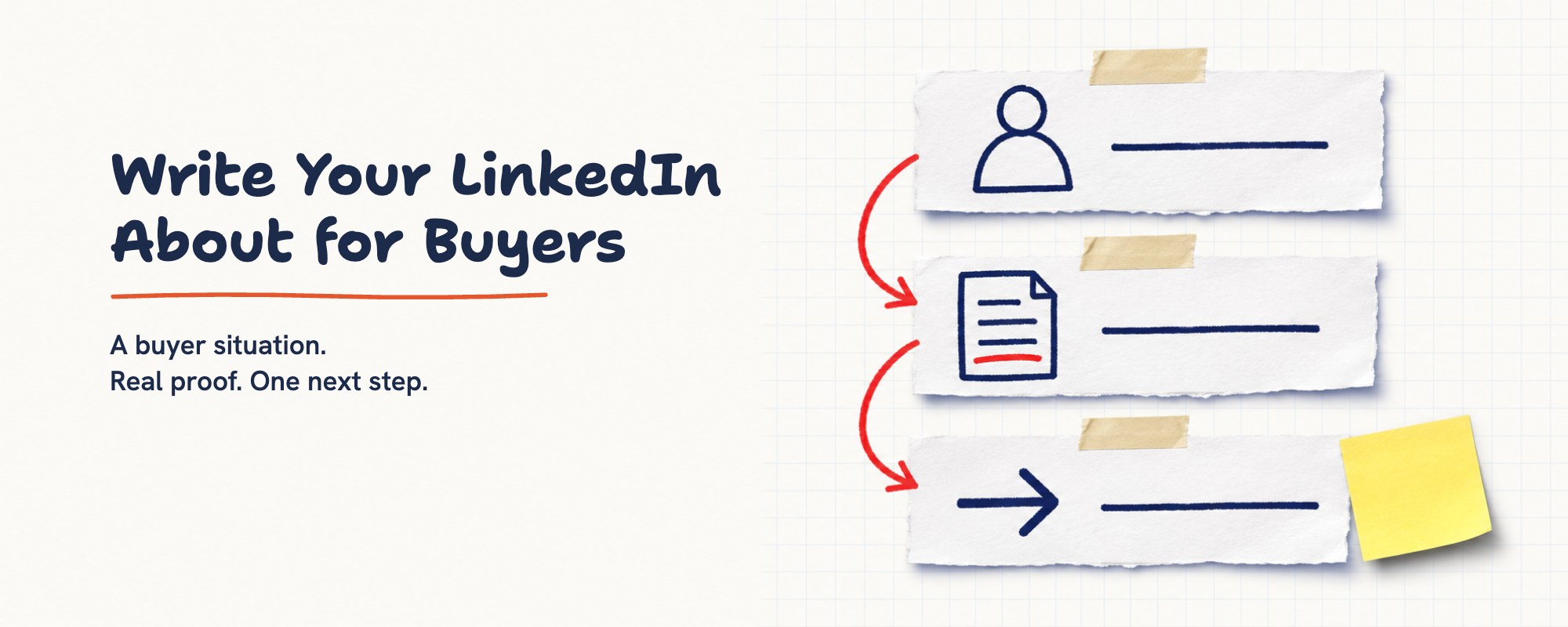
Choose the reader before rewriting the profile
A hiring manager and a customer may read the same profile with different decisions in mind. One is assessing suitability for a role. The other needs to understand what you can help them do now. Decide which conversation the current version should primarily support. A profile can serve more than one purpose, but a paragraph cannot quietly assume two different readers.
In Good Girls Get Rich, Karen Yankovich examines this problem through Celeste, a regulatory consultant. Yankovich explicitly says Celeste is a composite, assembled from several people. The episode compares career-led copy with an explanation addressed to the person considering her services.
The useful lesson is the change of reader, not a promise about conversion. We do not carry the composite's achievements into our own examples, treat its regulatory statements as expert guidance, or repeat the episode's search-ranking anecdotes as measured results.
LinkedIn's own guide to an effective sales profile also recommends explaining expertise from the buyer's perspective, with relevant credibility and an invitation to connect. That is practical platform guidance, not proof that a particular rewrite will win business.
Build a four-part evidence brief
Before polishing sentences, make a small brief. Keep the writing task separate from deciding what the business can actually promise.
- Reader and situation. Who needs this work, and what is happening? Use a recognizable business situation rather than a label such as “ambitious leaders.”
- Work. What do you actually do at that point? Name a deliverable, process or boundary that you can explain.
- Evidence. Why should this reader believe you? Verify ownership, dates, scope and permission before publishing a claim.
- Next step. What should an interested person send or ask? Make the request useful and proportionate.
A good opening might name a handoff problem, an upcoming renewal review or a specific operating constraint. It should not diagnose a stranger's business from a profile visit. Write for someone who recognizes the situation voluntarily.
Use your value proposition as input. If you cannot explain the offer in the brief, writing a more confident summary will not solve the missing definition.
Example 1: an independent operations consultant
Fictional starting point:
Experienced operations leader with a proven track record in transformation, stakeholder management and cross-functional excellence. Responsible for complex projects across fast-growing organizations.
This may describe a real career, but it leaves the buyer to infer the current service. The reader cannot tell what kind of operational problem merits a message.
Fictional rewrite:
I work with B2B service firms when a signed project reaches delivery without a clear scope, owner or first milestone.
My work starts with the existing proposal and a conversation with sales and delivery. We document what was promised, identify unanswered questions and build a handoff the project team can use.
My background is in operations and project delivery. I can share a redacted handoff example where permission allows; I do not share client information without approval.
If you are reviewing this handoff, message me with the point where work becomes unclear. We can establish whether a process review would be useful.
The rewritten version offers something assessable: a handoff, an approach and a boundary on evidence. The background sentence is deliberately modest. A real consultant must replace it if it does not describe their experience. There is no invented revenue gain or claim that every project becomes predictable.
Example 2: a software account executive
Fictional starting point:
Results-oriented account executive passionate about helping companies achieve digital transformation with innovative solutions. Consistently focused on exceeding expectations and building strategic partnerships.
A buyer who checks the seller's profile after receiving an email needs to connect the person to a recognizable product use case.
Fictional rewrite:
I work with finance teams evaluating software for reviewing invoice exceptions before month-end close.
I help organize the evaluation: which exceptions matter, who needs to review them, what evidence the team expects, and which questions require a specialist rather than a sales answer.
I can arrange a product walkthrough around an agreed example and explain the evaluation process. I do not promise an integration or accounting outcome before the relevant team has checked it.
If this is an active project, send me the workflow you are comparing and the next decision your team needs to make.
This is an example of positioning the seller's role, not a claim about Lead Scorer or any named accounting product. A real account executive should check product scope with their employer. If the role does not include evaluation design, the summary should not suggest that it does.
The profile and the connection request should be consistent. A careful summary cannot make an irrelevant invitation relevant.
Example 3: a founder without an approved case study
Fictional starting point:
Founder and visionary entrepreneur building the future of customer operations. Passionate about innovation, technology and delivering exceptional customer experiences.
A new business may have no publishable customer results. The answer is to describe current work precisely, while being clear about what is still being tested.
Fictional rewrite:
I am building a service for small support teams that need to turn recurring customer questions into usable help articles.
The initial assignment is deliberately narrow: review an agreed set of questions, draft a short article collection and have your team check the answers before publication.
I can show the review process and an illustrative sample. Those samples explain the work; they are not customer results or evidence of reduced support volume.
If your team is considering this job, send me the category of questions you would start with. We can discuss scope before deciding whether a paid assignment makes sense.
A process sample is useful evidence of preparation. It is not interchangeable with a client reference. Label it honestly and explain what a buyer can and cannot conclude from it. Our guide to client testimonials explains how to collect customer evidence when that becomes available.
Review every claim before making it public
Create a line-by-line record beside the draft. For a result, record the population, period, your contribution and permission to name the client. For a credential, check its exact wording and current status. For a deliverable, check that you can actually provide it.
Remove any sentence whose support is merely that it sounds plausible. Do not turn participation in a team project into sole ownership of the outcome. If you cannot publish a number, describe the work more precisely rather than inventing a substitute number.
You can use AI to reorganize approved facts, compare versions or identify vague language. Give it a bounded set of facts and require it to flag missing information. Keep dates, job titles, customer names and results under human review. Lead Scorer can support research and reviewed outreach preparation; a generated biography is not verification of your career.
Also check the headline and current experience entry. They should identify the same work as the summary. That is a consistency review, not a reason to delete a truthful employment history.
Run a comprehension review on desktop and mobile
Read the draft aloud, as Yankovich recommends. Mark phrases you would never say in a working conversation. Then show the opening to a colleague who has not helped write it. Ask them to explain who the work is for, what the person does and what an interested reader should do next.
This is a practical review exercise, not a validated scoring instrument. There is no universal number of opening lines visible on every device. Inspect the actual profile on desktop and mobile, including the collapsed opening, expanded summary and current-role entry.
Keep a dated copy of the previous version. Record relevant inquiries and what the person says brought them to you. Profile views can provide context, but a view does not identify intent or establish that the rewrite caused a conversation. A small number of visits is not enough to compare sales performance.
Frequently asked questions
What should a LinkedIn About section say for B2B sales?
Name the buyer and situation you help with, describe your approach, provide relevant evidence you can substantiate, and offer a clear next step.
Can I write a useful summary without revenue numbers?
Yes. Use specific work, deliverables, responsibilities or observations you can verify. A truthful description is more useful than an invented percentage.
Should I copy a LinkedIn summary example?
Use an example to understand structure, then rebuild it with your own audience, actual work and approved proof. The examples here are fictional.
Will rewriting my About section improve sales or search rankings?
This article does not establish that effect. Test whether readers understand your work, and record relevant inquiries separately from profile views.