Account Manager Responsibilities: Define Portfolio, Decisions and Handoffs
Define account manager responsibilities for a B2B customer portfolio. Use a practical role template covering deliverables, decision rights and internal handoffs.
By Lead Scorer 8 min read
Account manager responsibilities commonly include maintaining customer relationships, coordinating account work and developing commercial opportunities within an assigned portfolio. A useful role description also states which accounts belong to the role, what the person must deliver and which decisions need someone else's approval.
“Own the customer relationship” leaves those boundaries unresolved. Can the account manager approve a discount, promise an implementation date or close a support case? Write the answer before assigning the target. This guide offers an adaptable B2B role template, not a universal organization chart.
What does an account manager do?
An account manager maintains and develops a defined set of customer relationships. In this guide, the role concerns existing B2B customers. If your position also includes acquiring new customers, state that separately rather than hiding it inside “growth.”
Workable's account manager template includes client contact, internal coordination and account development. It is a starting point to customize, not evidence that every employer delegates the same powers. The word “manager” also does not establish whether the role has direct reports.
Before listing duties, specify the setting: products or services sold, customer types, contract model and teams available to support delivery. An agency account manager and a software account manager can share a title while handling different work.
1. Define the portfolio the person actually owns
Name the unit of ownership. It could be a customer organization, a local branch or one contract. Clarify whether related subsidiaries are included and how shared accounts are handled. “All existing customers” is insufficient when several people can contact the same group.
Document when responsibility starts. Is it after signature, after an accepted sales handoff or after onboarding? Record what happens when a customer changes segment, leaves the portfolio or needs a different commercial owner.
Also describe the means available: access to customer history, technical expertise, delivery contacts and approval routes. If the portfolio changes, review workload and expectations together. Do not copy an account-count benchmark from a different business model.
For detailed work on one important customer, use an account plan. The role description defines responsibility across the portfolio; the plan describes one account's situation.
2. Turn broad duties into observable deliverables
Use these responsibilities as a proposed starting set. Select and adapt them to the actual position.
- Understand customer priorities. Keep a dated account summary that distinguishes the customer's confirmed objectives from the team's assumptions. Record the relevant contacts and what still needs validation.
- Maintain a useful relationship. Prepare conversations around a customer decision or unresolved need. Leave a clear recap, agreed next step and owner instead of treating meeting volume as the outcome.
- Coordinate internal commitments. Get the receiving team to accept a request and communicate its status accurately. Passing an email to a shared inbox is not an accepted handoff.
- Prepare commercial conversations. Assemble the contract context, customer need and approved options before a renewal or expansion discussion. Use the renewal email guide when the next task is writing that message.
- Qualify account development. Check whether a new use case is real, relevant and commercially actionable before recording an expansion opportunity. A request for help is not automatically an opportunity to sell more.
- Keep account records reliable. Record commitments, their source and the next action in the agreed system. Correct outdated assumptions before another teammate relies on them.
Each duty should have a usable output. “Drive satisfaction” is too broad on its own; a documented unresolved issue with an accepted owner and a customer update is something a manager can review.
3. Separate coordination from decision authority
A customer-facing owner can coordinate a response without having authority to approve every part of it. Fill in the real decision owners before sharing the job description.
| Situation | Proposed account manager responsibility | Decision or resolution owner to name |
|---|---|---|
| Customer requests a price exception | Clarify the request and prepare the commercial context | Person authorized to approve that exception |
| Customer reports a technical problem | Route the issue, confirm acceptance and keep the customer informed | Team responsible for diagnosis and resolution |
| Customer asks for a delivery date | Obtain a validated commitment and communicate it accurately | Delivery team authorized to commit resources |
| Customer requests a new contract term | Gather the requirement and track the response | Authorized commercial or legal reviewer |
| Customer suggests a product change | Describe the need without promising a roadmap date | Product decision owner |
These are design prompts for your organization, not fixed boundaries between account management, customer success, sales and support. Small teams may combine roles. Combining roles still requires explicit approval limits.
Describe escalation as well: what needs escalation, to whom and what happens if that person is unavailable. The account manager should know how to move a blocked request forward without inventing a commitment.
4. Use this account manager role template
Complete the fields with the role's manager and the teams receiving its handoffs.
Purpose: maintain and develop the assigned B2B customer portfolio within the agreed commercial and delivery boundaries.
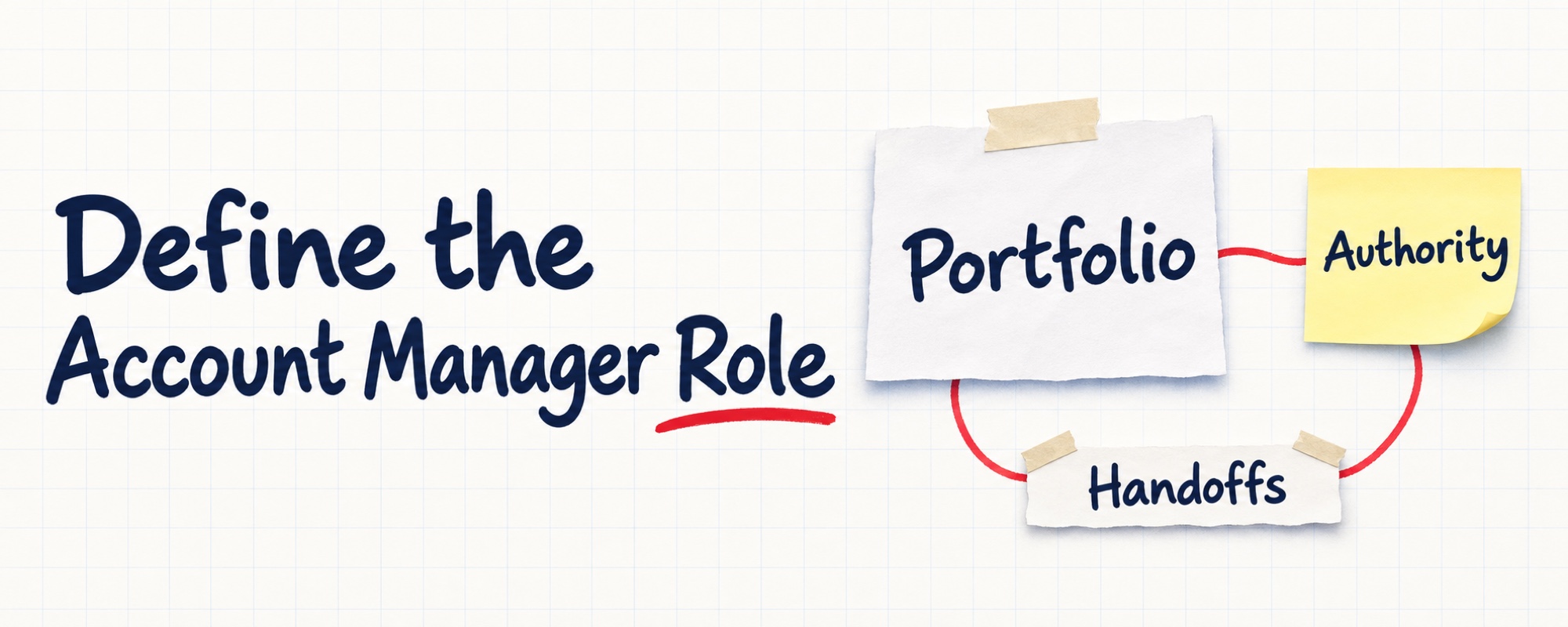
Portfolio: named customer segment, ownership unit, included entities, start and end of responsibility, rules for shared accounts.
Reporting line: manager of the role; direct reports, if any; commercial and operational interfaces.
Core deliverables: current account context, documented customer commitments, accepted internal requests, prepared commercial decisions and qualified development opportunities.
Authority: actions the person may take independently; exceptions requiring approval; people authorized to approve price, contract terms, delivery and product commitments.
Working conditions: systems, information, support contacts and relevant customer-contact expectations. Include the available means alongside the expected results.
Evaluation: agreed outcomes and evidence reviewed for the assigned portfolio, with definitions and a review period.
Skills: listening, clear writing, commercial judgment, coordination and the product knowledge needed for this scope. Describe the work a skill enables; avoid adding arbitrary credentials to make the template look complete.
If you are recruiting, take this scope into the sales interview guide. Candidate evaluation follows the role definition. If someone is joining, turn it into a sales onboarding plan with the right people and systems.
5. Test the role with a fictional customer request
A customer is approaching renewal and reports an unresolved access problem. The same contact asks for a lower price and wants to know whether a requested feature will ship soon.
The account manager first separates the requests. The access issue needs an accepted technical owner. The price request needs the appropriate commercial approver. The feature request needs an accurate product response, without an unapproved date.
A useful customer recap names the confirmed next steps and explains which answers are still pending. It does not describe the technical issue as fixed because someone received the message. It does not trade a discount for an undocumented delivery promise.
If no one can name the three decision routes, the role description needs more work. Another general responsibility such as “ensure client success” will not resolve that gap.
6. Review outcomes with the right context
Choose measures that match the role's actual influence. If renewal revenue is included, define the eligible contracts and period. If expansion is included, distinguish a qualified opportunity from a signed sale. If customer issues are reviewed, separate coordination quality from technical resolution owned elsewhere.
Pair an outcome with the evidence needed to interpret it. A lost renewal might involve pricing, product fit or a customer decision beyond the role's control. This does not remove accountability; it makes the review useful.
Review the scope again when accounts, approval rights or supporting teams change. A role description should remain a working agreement rather than an archived hiring document.
Start with one clear working agreement
List the portfolio, choose the core deliverables and name the decision owners. Then test one real customer request against those boundaries. Resolve the missing owner before adding another target.
For teams that also need to find and qualify new B2B contacts, open Lead Scorer. Keep that prospecting work distinct from the account ownership and approval rules defined here.