The First 100 Customers Course #42: Assured Secured Two Clinic Commitments Before Incorporation
Assured secured two clinic commitments before incorporation. Learn the trust, narrow-workflow, and specialty-reference sequence behind its first sales.
By Miljan @ Lead Scorer 15 min read The First 100 Customers Course · Lesson #42
Two customers committed to Assured before it was incorporated. They were not strangers reached by an automated campaign. Co-founder Rahul Shivkumar says they were friends the founders had met while operating a virtual sleep clinic, and both were building similar healthcare businesses. That distinction is the lesson: the first sale borrowed trust from work already done, then tested whether the problem extended beyond those friends.
TL;DR: Assured used operator knowledge to identify one expensive, neglected workflow: getting newly hired clinicians credentialed and enrolled with insurers so they could see billable patients. The founders secured two commitments before their March 2024 incorporation, used people to make the early service reliable, and grew through referrals and references inside healthcare specialties. The interview does not show that this motion alone produced 100 customers. It shows how to earn the first two commitments and turn them into a repeatable test.
What you will build
You will leave with a one-workflow offer, a list of ten organizations that experience it, a reliability plan for the first delivery, and a reference test inside one buyer group. You will also have a rule for when to move beyond warm contacts. This is a course for a founder who can build an AI application but has not proved that the buyer wants the outcome.
It fits a problem you have done yourself or observed directly in an operating role. It also fits a workflow where errors cost the customer money, time, or trust, because the offer can be framed around an outcome rather than a feature list. It does not fit a founder who has no access to the workflow, no way to check output quality, or only a vague claim that every company could use AI.
Case snapshot: what the sources actually establish
| Stage | Evidence | What it does not prove |
|---|---|---|
| Prior operating experience | The founders had run Dawn Health, a virtual sleep treatment clinic that had to hire clinicians and enroll them with insurers. | Domain experience alone does not make a scalable channel. |
| January to March 2024 | Shivkumar says two customers committed before Assured incorporated in March 2024. They were friends met through Dawn. | Their contract values and exact payment dates are not disclosed. |
| About month five | Four new customers arrived in one week. Shivkumar estimates early contract values around $60,000 annually. | Four arrivals in one week is not a stable monthly acquisition rate. |
| About twelve months | Shivkumar says Assured reached roughly $1 million annual recurring revenue. | ARR is not a customer count, and this does not show the path to exactly 100 customers. |
| Later growth | A dermatology practice became a reference for other dermatology practices. A later team used human BDRs and cold calls. | Later BDR conversion rates should not be projected backward onto the first two customers. |
The interview is the direct source for the sequence and founder-reported numbers. Insight Partners independently confirms the founders' earlier clinic experience and subsequent Assured founding. Axios separately reported the later $19 million Series A. Those later funding facts establish the company's existence and trajectory; they are not proof that a particular early tactic caused the outcome.
The model: trust, outcome, proof inside a narrow cohort
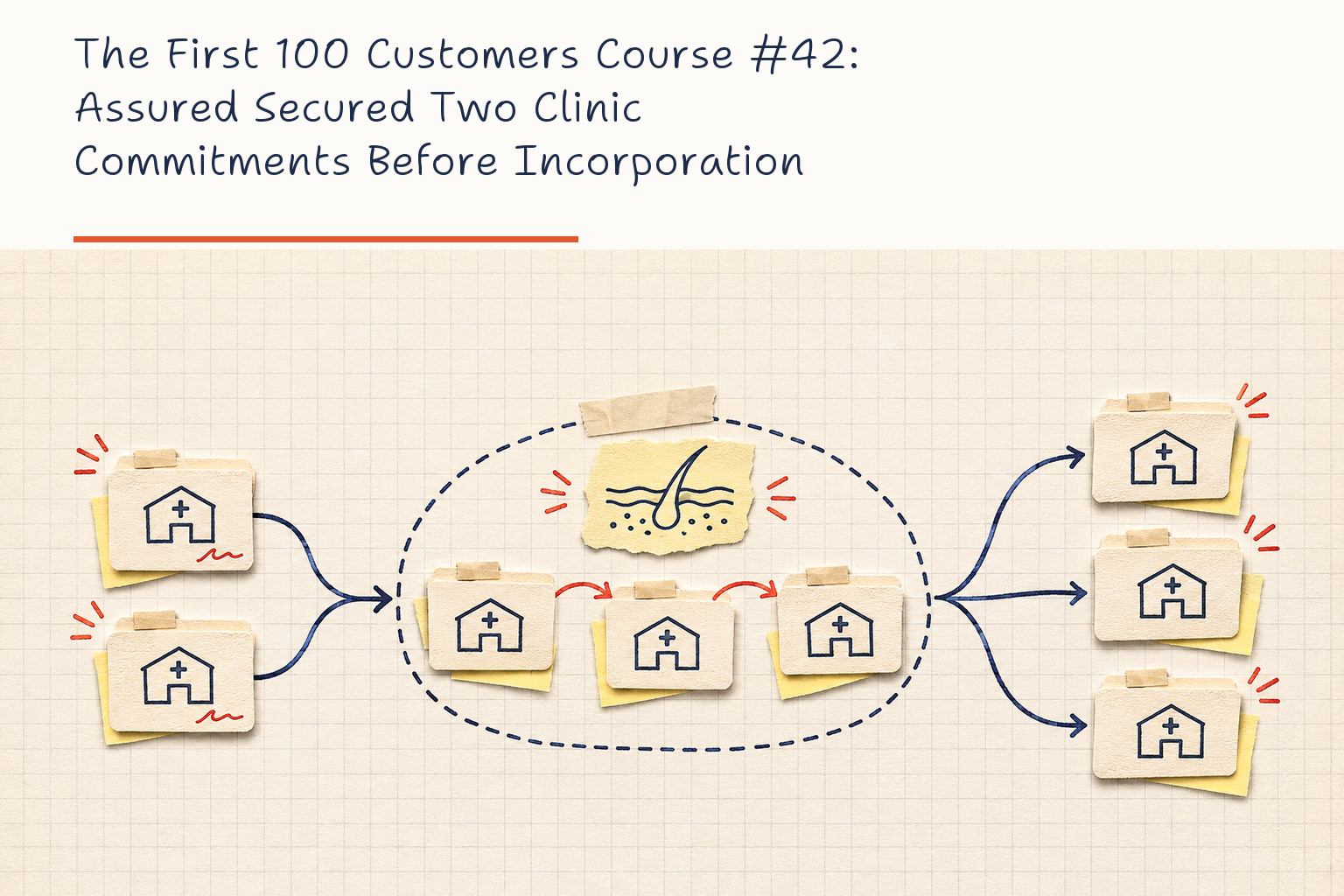
Assured's first distribution mechanism had five links. First, the founders had felt the credentialing and payer-enrollment problem as clinic operators. Second, they chose a workflow they could describe in the buyer's own operating terms. Third, two relevant contacts committed before a finished product existed. Fourth, human review made the early delivery safe enough to use. Fifth, customer referrals and a specialty-specific reference helped the founders reach people beyond the original relationships.
The weakest link for most AI founders is the jump from two friendly buyers to a market. A warm buyer can validate that the problem is real for that buyer. It cannot validate the price, delivery cost, or sales path for strangers. This course treats the first two commitments as the start of a test, not as product-market fit.
Step 1: start with a cost you have seen yourself
The founders' prior clinic, Dawn Health, hired providers and depended on insurer payments. A clinician could not simply start seeing billable patients when an offer letter was signed. Credentialing, insurance enrollment, and follow-ups had to happen first. Shivkumar says there were products for other revenue-cycle tasks, but little they wanted to buy for this front-door workflow. Their own team had to staff it.
Write one operating sentence before you write a product pitch: “When [specific worker] must [workflow], [current process] delays [valuable outcome] because [constraint].” For Assured, the worker was a healthcare operations team, the workflow was enrolling a clinician with payers, and the outcome was a provider who could see insured patients and generate billable work. A generic “AI for healthcare administration” line would have hidden the cost.
Then document one real instance. Record the task owner, the tools used, elapsed time, error points, and the buyer who controls the budget. Ask whether the buyer already pays people to do the job or loses revenue while waiting. If you cannot name a recent instance and an owner, stop. More model building will not repair a missing customer problem.
Output: a one-page workflow map and two recent examples. Pass condition: an operator can recognize the workflow without a demo. Stop condition: the only evidence is your own prediction that an AI assistant would be useful.
Step 2: earn a commitment before treating interest as demand
Shivkumar says the first two customers committed in January 2024, before the formal company launch. They knew the founders through Dawn and were building similar businesses. That made the first conversation easier: the buyer did not have to guess whether the sellers understood insurance operations. The founders could speak from a real clinic's experience.
Copy the test, not the relationship. Start with people who can tell you whether the workflow matters, then ask for an explicit next step: a paid pilot, a contract conditional on delivery, or access to a real workflow with a named owner and start date. Log exactly which commitment you obtained. An introduction, an encouraging call, and a signed agreement are different evidence.
Use a simple commitment note:
- What happens today, and who does it?
- What does delay or error cost in this organization?
- Which minimum outcome would make the trial worth the buyer's time?
- Who approves the trial and supplies the data?
- What will be paid, signed, or scheduled, and by when?
Do not extrapolate from a friendly buyer. After the first two, test five organizations without the same relationship. Compare their problem language, willingness to share real examples, buying path, and objections. If strangers do not recognize the problem, revisit your segment before adding features.
Output: two explicit commitments and five independent discovery conversations. Pass condition: at least one independent buyer agrees to a concrete trial step. Stop condition: every “yes” depends on personal goodwill and disappears when you ask for a date or scope.
Step 3: choose a reliable, narrow result
Assured could not sell a workflow that was merely “mostly right.” Shivkumar points out that 80% accuracy would leave too many clinicians outside the intended insurer network. The first version therefore kept a person in the loop. A human on Assured's team or the customer's team checked some steps before submission. Corrections became feedback for engineering and the automation.
That is a distribution decision, not only a product decision. A buyer who cannot trust the output will not refer a peer, regardless of how impressive the demo looks. An early AI service can use people behind the scenes while it learns the edge cases. The founder must price and scope the work honestly, because human review changes the margin and delivery time.
Define one measurable result and an audit method. In a lower-stakes product, it might be a reviewed, accurate lead list for one niche. In a regulated workflow, it may require qualified human sign-off and a much stricter reliability standard. Keep the first scope narrow enough that every output can be checked. For each exception, record what failed, who corrected it, and whether the same correction can be made systematic.
Output: a written acceptance checklist, error log, owner for review, and expected turnaround. Pass condition: the buyer can use the result safely under the agreed process. Stop condition: success depends on hiding manual effort or treating unverified AI output as finished work.
Step 4: make the first reference relevant to the next buyer
The interview describes early word of mouth and a later dermatology practice that became a useful reference for other dermatology practices. Shivkumar's point is precise: a large general health-system logo may not reassure a specialty practice with different operating conditions. A small but close peer may carry more weight. He says the team learned to get an initial logo in each new specialty, even when early terms were less attractive.
This is a cohort rule. Pick one narrow buyer group, then ask what proof that group will trust. Capture the exact workflow, the before-and-after process, and the limits of the result. Request permission before naming a customer. If a named case is unavailable, use an anonymized process example with no invented numbers. Do not imply that one customer's outcome applies to every specialty.
Build a reference ladder:
| Rung | Asset | Decision gate |
|---|---|---|
| First delivery | A verified account of the workflow completed | Could the buyer use it reliably? |
| First repeat | A second delivery in the same buyer group | Did the same problem and acceptance test recur? |
| Peer proof | An approved customer reference or anonymized case | Would a similar buyer recognize its own context? |
| Expansion | A new specialty or segment | Is the new workflow similar enough to reuse the delivery system? |
Output: one approved case note and a list of five same-group prospects. Pass condition: a buyer can see that the proof came from a comparable organization. Stop condition: the next segment needs a different workflow, buyer, or compliance path that you have not mapped.
Step 5: choose the channel from observed behavior
Assured's later sales team chose people over AI BDRs. Shivkumar says healthcare buyers answered cold calls at around an 8% rate in their experience, while the AI calling tools they examined performed poorly on the phone. Six human BDRs later made roughly 150 to 200 calls each per day and booked about two meetings per person per week. These are later-stage, founder-reported figures. They explain a channel choice; they are not a prescription for a two-customer startup.
The founders' earliest channel was their existing operator network, followed by referrals. Only after they understood the buyer and the offer did a larger outbound system make sense. The lesson is to measure how a specific buyer responds. If your target group answers calls, phone may deserve a test. If they publicly ask for help in a community, a useful answer there may be the better opening. An AI-generated email volume target is not evidence of demand.
Run a small channel test with the same offer and buyer definition. Try ten relevant warm introductions, ten carefully selected cold contacts, and ten public problem conversations if those exist. Track replies, qualified conversations, concrete trials, and the work needed to deliver each trial. Do not compare only opens or impressions. A channel is useful when it produces buyers who can use and pay for the outcome.
Output: a channel ledger with source, buyer role, problem, next step, and final result. Pass condition: the next buyer comes through a path you can deliberately repeat. Stop condition: activity rises while qualified trials stay at zero.
What failed, and what remains unproved
Assured did not abandon automation as a product. It rejected AI BDRs for a particular sales channel because the buyers' phone behavior and the tools' call quality did not fit. That is a later-stage channel choice. Earlier, the company learned that a generic demo was less effective than discovery followed by a focused demonstration. Shivkumar reports a change from roughly 18% to 40% demo-to-close, but the interview does not isolate discovery as the only cause. Product scope, team experience, and customer mix also changed.
The ROI pitch also split by customer. Faster clinician enrollment matters when delays prevent billable appointments. For an organization with enough available providers and limited patient demand, speed may not create incremental revenue. That buyer may care more about avoiding additional administrative hires. Ask which constraint is real before using a calculation.
There is no verified breakdown of the first ten customers by source, no independent audit of the $1 million ARR claim, and no evidence that the first two friend commitments were priced like later contracts. A company announcement and industry coverage give different later organization counts. Neither is needed to teach the early mechanism, so this course does not turn those figures into a customer milestone.
A seven-day implementation plan
Day 1 — Map the pain. Observe or reconstruct one recent workflow. Write down the operator, delay, error risk, and economic consequence. Output one page, not a feature backlog.
Day 2 — Narrow the buyer. Choose one buyer group with the same workflow and approval path. Name ten organizations and the person closest to the problem. Reject organizations whose workflow is materially different.
Day 3 — Run discovery. Speak with at least three operators. Ask for the last real occurrence and what happens when the process fails. Note their words and the current workaround.
Day 4 — Propose an outcome. Write a scoped trial with deliverable, review owner, timing, and price or signed commitment. Do not lead with the model or the interface.
Day 5 — Deliver with review. Manually check every result. Record errors and time spent. If you cannot deliver safely, narrow the task before inviting more customers.
Day 6 — Ask for a relevant reference. With the buyer's permission, capture the workflow and measured result. Write down what a peer in the same group would need to see.
Day 7 — Test beyond friends. Contact five relevant organizations without a personal relationship. Your next decision is based on whether they recognize the same problem and agree to a real trial, not whether they compliment the demo.
Implement the research loop with Lead Scorer
Lead Scorer can organize the manual research and draft outreach, with the founder approving consequential steps. Use it when the buyer group is identifiable and the offer is already scoped. It cannot supply firsthand clinic knowledge, certify a regulated workflow, guarantee replies, or replace customer permission for a reference.
First, define the ICP in plain language. For example: “US multi-site dermatology practices adding clinicians, with a named operations owner and a recent payer-enrollment bottleneck.” Add disqualifiers: practices with no near-term hiring, no relevant insurer workflow, or a different specialty that needs a new proof case. Use the ICP and offer context skill to store the promise and evidence limits. Then use the daily vertical prospecting skill to find a small company set, and the ICP scoring rubric to score fit before paying to enrich contacts.
Keep three lists separate: warm operator contacts, same-specialty strangers, and adjacent-specialty experiments. This makes the second test legible. A warm referral and a cold prospect are different acquisition paths. Give each record a source, a date, the role, a verified reason for fit, and an explicit next step. If the relevant Lead Scorer MCP is connected, create the list and lead records there; inspect the available tool schema before choosing the exact actions. Do not claim an unavailable action was run.
Only enrich high-fit keepers. The contact discovery skill calls for verified emails and phone numbers after ICP confirmation, and the lead enrichment pipeline adds quality gates before a campaign is ready. Check credits and any confirmation gate before bulk enrichment. Reject uncertain numbers and missing sources instead of filling cells with guesses.
Draft a first touch with the cold email first touch skill. It should refer to one verified signal, name the workflow problem, and ask for one small conversation. The outreach QA audit skill then checks unsupported personalization and vague claims. A sample agent request is:
Find ten dermatology practices with evidence of clinician hiring. Score them against my saved ICP. Enrich only the keepers after the credit check. Draft one evidence-based email per keeper about payer-enrollment delays. Leave every message as a draft for my review.
Review every draft and approve any campaign action yourself. If a prospect replies, use reply triage to classify the response and record objections. Turn repeated objections into a better discovery question or a source-backed Content Studio note. Capture people who engage with that useful content as a separate signal audience, score them again, and keep them apart from the original cold list. This is the feedback loop: buyer evidence changes the offer, the list, and the next message.
Pass condition: every keeper has a source-backed fit reason and every draft has a real buyer problem. Stop condition: the workflow would spend credits or send outreach before the founder has checked fit, facts, and the intended promise.
Saveable checklist
- Name one workflow you have observed directly.
- Find its owner and its current economic cost.
- Ask for a scoped commitment before building a broad product.
- Mark warm commitments separately from stranger validation.
- Use human review until the result is reliable enough for its risk.
- Make the first proof relevant to the next buyer's narrow group.
- Choose the channel from observed buyer behavior.
- Track qualified trials and delivery work, not activity alone.
Sources and evidence limits
The primary source is Rahul Shivkumar's November 2026 interview, audited end to end for this course. The two early commitments, four-customer week, early annual contract estimate, $1 million ARR timing, referral motion, and later sales metrics are his recollections. Insight Partners' founder profile corroborates the prior clinic and the later founding. Axios' funding report independently confirms the financing event, not the early acquisition sequence.
Assured had not disclosed a source-by-source count for the first ten buyers in the material reviewed. The course therefore teaches a testable mechanism from the first two commitments and the later specialty reference, without claiming an exact first-100 path.
Frequently asked questions
Did Assured get 100 customers through this early motion?
The interview establishes two pre-incorporation commitments and later early growth. It does not establish how Assured reached exactly 100 customers.
Were the first two customers cold outreach wins?
No. Co-founder Rahul Shivkumar says they were friends met through the founders' prior healthcare business, Dawn Health.
What should a founder without a healthcare network copy?
Copy the sequence of firsthand problem discovery, narrow buyer qualification, a reliable manual-backed outcome, and references inside one buyer group. Do not assume the warm introductions transfer.