Customer advisory board: charter, members and decision follow-through
Build a B2B customer advisory board with a clear charter, deliberate member selection and a record linking advice to decisions. Templates and a worked example.
By Lead Scorer 8 min read
A customer advisory board becomes useful when customers can influence an unresolved business decision and later see what happened to their advice. Start with that decision, the people qualified to discuss it and a written commitment to respond. Send invitations only after those three elements are credible.
This guide provides an adaptable charter, a member-selection method and a decision-return workflow for B2B teams. The templates and worked example below are editorial proposals, not a description of a Lead Scorer feature or a customer result.
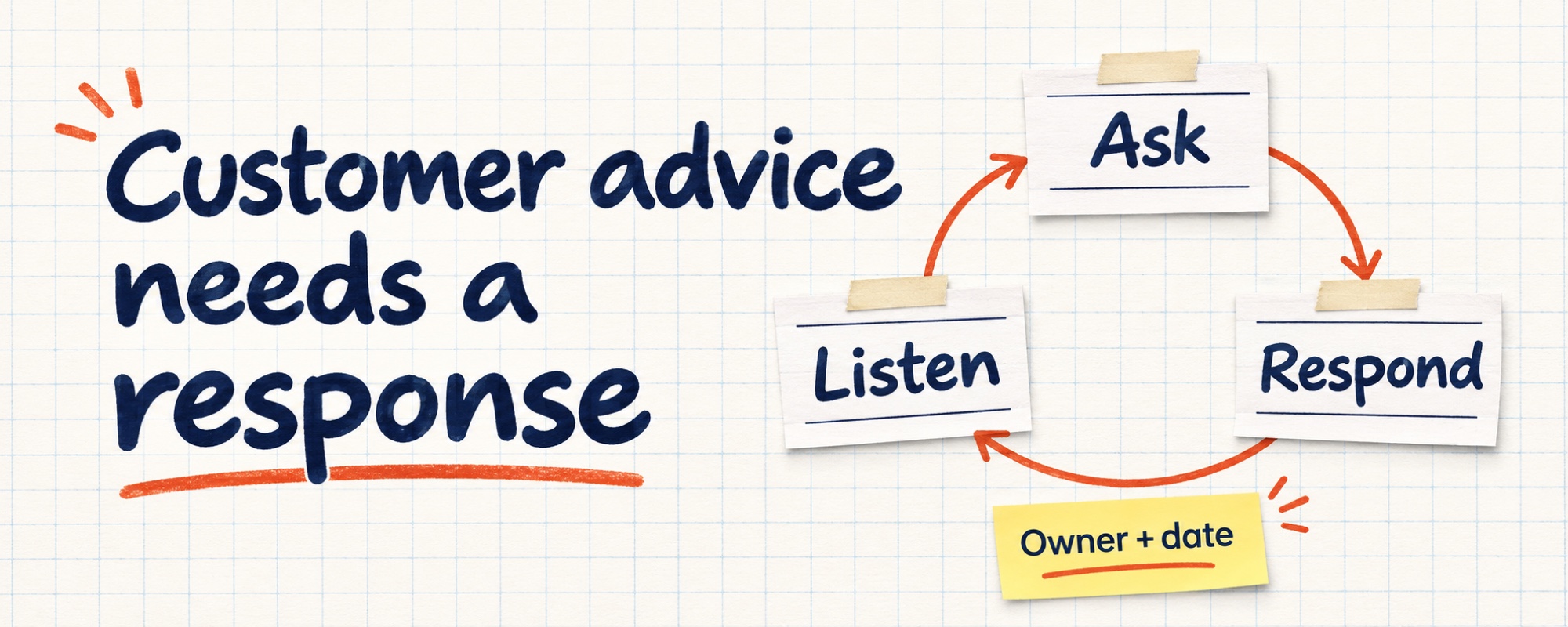
What is a customer advisory board?
A customer advisory board, or CAB, is an ongoing consultative group of customers that helps a company examine strategic choices. Participants contribute experience from their own businesses; company leadership remains responsible for decisions.
Insight Partners’ CAB guide emphasizes the program’s strategic role. A useful boundary is to ask how customers’ businesses are changing before asking which feature they want next.
Choose the appropriate listening format:
- An individual account review examines that customer’s outcomes and next steps. Use a QBR agenda for this purpose.
- A product interview explores a user’s specific workflow or a proposed solution.
- A survey gathers comparable answers from a defined population.
- A CAB brings selected customers together to challenge an unresolved strategic assumption across accounts.
One format can inform another. A board’s discussion still does not establish how common a view is across your market. Record its composition and test consequential assumptions beyond the members.
1. Write the decision before the charter
Replace “get closer to customers” with a choice that a named executive expects to make. For example: “Should our next service model prioritize local autonomy or centralized coordination for customers expanding into multiple regions?”
State what remains open, what is already constrained and when input can affect the choice. If implementation has already begun and alternatives cannot be considered, explain that honestly and use a different research format.
Ask the executive sponsor to confirm three conditions: access to the eventual decision-maker, time to review findings and authority to assign follow-up work. Marketing can coordinate the program, but coordination alone cannot guarantee a response from leadership.
2. Adapt this customer advisory board charter
CRV’s CAB guide discusses explicit objectives, program ownership and member expectations. The following one-page structure translates those principles into a working document. Fill in each field with your own commitments.
Purpose: The business change we want to understand, and the strategic choice that discussion will inform.
Scope: The decisions open to advice, the topics handled elsewhere and the boundaries participants should know before accepting.
Membership: The customer experiences needed, the selection criteria, the term and how membership will be reviewed.
Commitment: The planned sessions, preparation, format, accessibility needs and expected time. Choose a schedule your team can actually support; there is no universal cadence.
Member value: Relevant peer exchange, a chance to question leadership and a clear account of how advice was considered. Promise only benefits you can provide.
Ownership: Executive sponsor, facilitator, program coordinator and person responsible for each decision response.
Information handling: What may be recorded, who receives notes and how attributable remarks or public references will be approved. Do not treat participation as permission to use a customer’s name in marketing.
Return: When members will receive a synthesis, how they can correct it and when the company will communicate a decision or an explicit pending status.
Keep an internal version with budget and staffing details. Share a member-facing version that makes participation and expectations understandable. Resolve material uncertainty before requesting commitment.
3. Select for the question, then inspect the gaps
Build a candidate sheet around the decision. Suggested columns are customer segment, operating model, relevant experience, role, maturity, perspective missing from the group and reason for invitation.
For the regional-service example, headquarters buyers alone may miss local coordination problems. Local users alone may miss company-wide constraints. Decide whether to invite those perspectives together or gather additional evidence separately.
Review the proposed group for three distortions:
- Revenue bias: Large accounts receive every seat because they are commercially important.
- Enthusiasm bias: Only advocates comfortable praising the company are invited.
- Availability bias: The easiest people to schedule become the apparent market.
Do not imply statistical representation. Document which experiences are covered and which are absent. Someone with a difficult onboarding experience may be highly relevant, but unresolved support work needs its own owner before the board convenes.
An invitation should explain the question, why that person’s experience matters, the commitment and the return. Give candidates a practical way to decline or ask for clarification.
4. Prepare a discussion that can change your mind
Send a short background note with the choice under consideration, known constraints and questions. Avoid presenting one preferred answer as the only reasonable option.
A useful sequence is: individual reflection, customer examples, comparison of differences, exploration of trade-offs and a recap of what remains uncertain. Ask for situations and consequences before collecting solution requests.
For example: “When regional teams need an exception, who can approve it today?” Follow with: “What becomes difficult when another region joins?” Then ask what would have to be true for either service model to work.
Keep facilitation separate from advocacy for an internal proposal. Invite quieter members to contribute without requiring agreement. Capture minority views and the operating conditions behind them; a disagreement may reveal two different customer needs rather than a winner.
5. Keep an advice-to-decision record
Pragmatic Institute’s guidance calls for communicating actions back to members. Use a small record to make that response concrete:
| Field | What to record |
|---|---|
| Question | The choice discussed and its owner |
| Evidence | Customer situations, conditions and disagreement |
| Interpretation | What the team thinks the input means |
| Decision | Proceed, investigate, defer or decline, with a reason |
| Next step | Owner, next update date and intended recipient |
Separate what participants said from what your team inferred. If you also analyze interview language for positioning, the voice-of-customer workflow helps retain that distinction.
In a fictional example, members disagree about centralized service. The useful finding is that approval authority differs by region. The sponsor commissions further interviews before choosing a model and sends members that explanation. No feature promise is needed to show that their contribution mattered.
6. Review the program by its follow-through
Track whether summaries were returned, corrections resolved and decision responses delivered on the promised dates. Note which strategic assumptions changed and which still lack evidence. These are operational checks, not proof of revenue uplift.
For a current example of a reciprocal participation offer, HubSpot’s October 29, 2026 announcement sets out its own CAB commitment and member benefits. Those terms describe one vendor’s program; they are not a benchmark for yours.
Before inviting anyone, ask: can we explain the open decision, justify the member mix and name the person who will return a response? If one answer is missing, repair the charter first.
Explore Lead Scorer to organize your B2B prospecting work. Keep the advisory board’s mandate and decision record in the system your program owners actually maintain.