Quarterly Business Review Agenda: Decisions Before Slides
Prepare a customer QBR with an outcome record, a practical agenda and a written action plan. Separate usage from value and leave with decisions both teams understand.
By Lead Scorer 7 min read
A quarterly business review agenda should make room for a customer decision. A full deck of usage charts can leave the important questions unanswered: did the customer's work improve, what is blocking progress, and what should both teams do next?
Prepare the decision and its evidence before preparing slides. The workflow below includes a shared outcome record, an illustrative 45-minute agenda and a follow-up format. Adapt the timing to the account; it is a planning example, not a benchmark for an effective meeting.
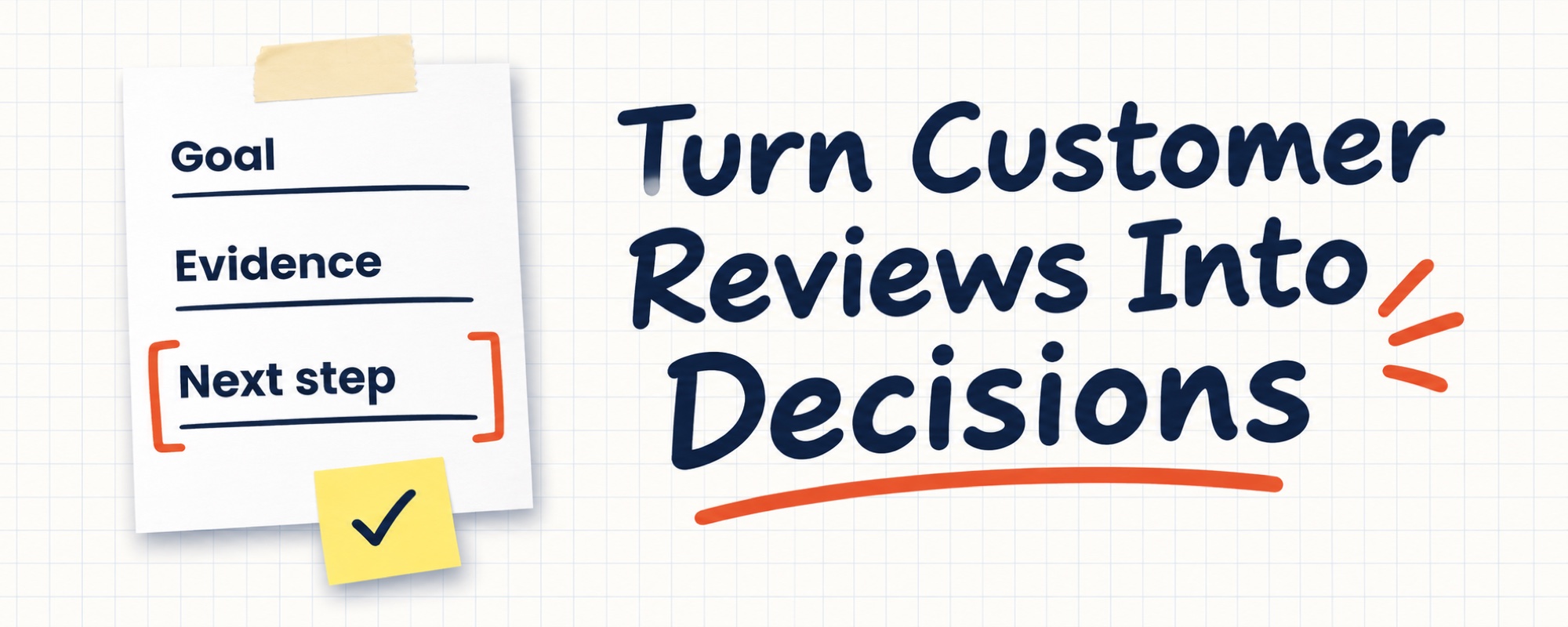
Decide which review you are running
A customer QBR examines the results and priorities of an existing business relationship with the customer. An internal sales review examines your own performance. A sales account plan coordinates your team's understanding and next moves. They may share facts, but they should not share every objective or every slide.
ChurnZero's QBR guidance centers the customer's objectives, value and next steps, with preparation and written follow-through. That is a useful scope for the customer meeting. It does not establish that holding a review causes renewal or expansion.
Ask the customer what would make the review worth attending. A new operational lead may need to revisit the original goal. An executive sponsor may need to choose between two priorities. A routine support update can often happen elsewhere. Do not hold an elaborate meeting solely because the calendar says the quarter ended.
Build a shared outcome record
Start with the result the customer wanted, including changes since the previous review. Recover the agreed scope from onboarding or the last action plan, then ask whether it still matters. A target that has become irrelevant should not remain green in the deck just because it is easy to report.
For each result under discussion, record:
- Goal: the customer's desired change and the person who confirmed it.
- Measure: the unit, population and period used to assess progress.
- Starting point: a dated baseline, or an explicit note that it is unavailable.
- Observation: the current evidence, source and important exclusions.
- Customer interpretation: whether the evidence reflects a useful improvement in their work.
- Next decision: continue, adjust, investigate or stop, with the unresolved question.
Keep activity and outcome separate. More active users may show adoption, while the customer still spends the same time correcting reports. Lower activity can also accompany a simpler workflow. Neither pattern explains business value without context. Retain qualitative evidence when that is what you have; do not manufacture a financial return to fill a slide.
Agree on the pre-read and participants
Send a short proposed agenda and the outcome record ahead of the meeting. Ask the customer to correct the priorities, provide missing observations and add a decision they need from the conversation. Mark open questions where an input has not arrived, rather than quietly filling them with assumptions.
Invite people for the decisions they can inform or make. The operational owner can explain the workflow, while a sponsor may choose priorities or resolve a dependency. Confirm who can authorize a resource commitment. A title alone does not establish that responsibility.
Separate urgent service work from meeting preparation. If a serious issue is preventing the customer from working, assign it through the appropriate support route immediately. The review can examine its wider effect, but should not become a reason to postpone the response or make the customer repeat the entire ticket history.
An illustrative 45-minute QBR agenda
This allocation protects time for discussion. Shorten, extend or replace the meeting when the customer needs something different.
| Time | Conversation | Useful output |
|---|---|---|
| 5 minutes | Confirm current priorities and the decisions needed today | A shared purpose for this review |
| 10 minutes | Review previous commitments, including incomplete work | Confirmed status and remaining obligations |
| 15 minutes | Examine results, gaps and the customer's interpretation | Agreed observations and explicit unknowns |
| 10 minutes | Choose the next period's priorities and trade-offs | A limited set of decisions |
| 5 minutes | Confirm owners, dates and the next check | An action record both teams can correct |
Open with the customer's change in circumstances, not your company news. Show only evidence relevant to the decision being discussed. Keep detailed usage reports available behind the summary so a participant can inspect them without turning the meeting into a tour of every metric.
When a result is challenged, record the disagreement and the information needed to resolve it. A shared record need not pretend everyone agreed. If the necessary decision-maker is absent, state which choice remains open and how it will be taken afterwards.
Example: adoption without a confirmed business result
Consider a fictional reporting service used by a distributor. More branch staff are using the service, but the finance team still manually checks the monthly consolidation. No comparable baseline for that effort was established. These are illustrative circumstances, not a Lead Scorer customer case.
The account team could present increased usage as a success. A more useful review asks what changed in the reconciliation work. The finance lead explains that inconsistent source definitions remain a problem. Usage is observed; reduced effort is not established.
The teams agree to define a common input checklist and observe the next consolidation cycle. The service owner will document the definitions; the customer will identify who validates each input. They also agree what would count as an improvement and which observations can be collected. That creates a reviewable next step without inventing a saving or promising a product feature.
End with an action record, not an implied commitment
Summarize each decision in language the customer can correct. A compact follow-up should contain:
- The priority and observation the decision addresses.
- What was agreed, what was rejected and what remains open.
- One owner for each action, with dependencies on the other team.
- A due date or agreed trigger for the next update.
- The evidence that will make progress visible.
Distinguish a supplier recommendation from a customer commitment. “We suggest involving finance” is not the same as “The customer will arrange finance approval.” Apply the same discipline to your own roadmap or delivery promises: the meeting cannot authorize work your team has not approved.
Use the sales meeting notes framework to preserve statements, decisions and actions separately. Share the agreed record promptly and invite corrections. Follow the agreed update trigger; do not wait until the next quarter to notice that a dependency never arrived.
Keep the review useful as the relationship changes
A quarterly cadence is a convention, not a reason to require the same format for every account. Choose the next useful review around the customer's decisions and the time needed to observe progress. A short written update may be enough when there is no new choice to make.
Track whether actions were completed, questions were resolved and the customer confirmed the interpretation of results. Attendance, deck length and number of meetings do not establish value. Our customer retention guide covers the wider relationship; the QBR is one opportunity to make its next decision explicit.
Prepare one outcome record before building a larger deck. Explore Lead Scorer for the prospecting work upstream, and keep the customer review focused on the results and commitments that both teams can inspect.
Frequently asked questions
What should a quarterly business review agenda include?
Include the customer's current priorities, previous commitments, evidence of outcomes, unresolved obstacles and decisions for the next period. Finish with agreed actions, owners, dates and the evidence needed to review progress.
Is a QBR the same as an internal account review?
A customer QBR is a conversation with the customer about their outcomes and next decisions. An internal account review coordinates your team's relationship and commercial work. Prepare each for its own audience.
What if there is no credible ROI figure for the QBR?
Show what is observed, what the customer confirms and what is still unknown. Agree how to establish a useful baseline or test an outcome. Do not convert usage or an estimate of time saved into a verified financial return.