Customer Winback Email: Give Former B2B Customers a Reason to Return
Write a customer winback email for former B2B customers. Three examples, a reason-to-return worksheet and checks that separate replies from a real return.
By Lead Scorer 8 min read
A customer winback email asks a former customer whether a relevant new purchase or return is worth considering. In B2B, start with the reason the relationship stopped and what has changed since. A familiar company name alone is a weak reason to send another offer.
This guide focuses on people who previously paid for your product or service. It provides a selection worksheet, three fictional email examples and a way to record an actual return. The worksheet is an editorial method, not a claim about a Lead Scorer automation or a proven conversion uplift.
Which customers belong in a winback campaign?
Distinguish four records before writing:
| Record | Question to resolve |
|---|---|
| Former paying customer | Is a new purchase or return relevant now? |
| Current customer with low activity | Do they need help with the service they still have? |
| Prospect who never purchased | Has the reason for not buying changed? |
| Quiet newsletter subscriber | Do they still want this content? |
These groups can all look inactive in an email tool. Their commercial relationships differ. Use lead nurturing for prospects and a renewal email for an arrangement approaching its next decision. Do not classify an active annual customer as lost because their last payment was months ago.
Mailchimp’s re-engagement guidance recommends defining inactivity around the product’s buying cycle. Apply that idea to your actual relationship: a completed project, a canceled subscription and a seasonal purchase need different review points.
1. Build a reason-to-return worksheet
For each former account, record the following before drafting:
- Past purchase: service, scope and a source confirming the relationship.
- Departure: when it ended, the stated reason and whether that reason is known.
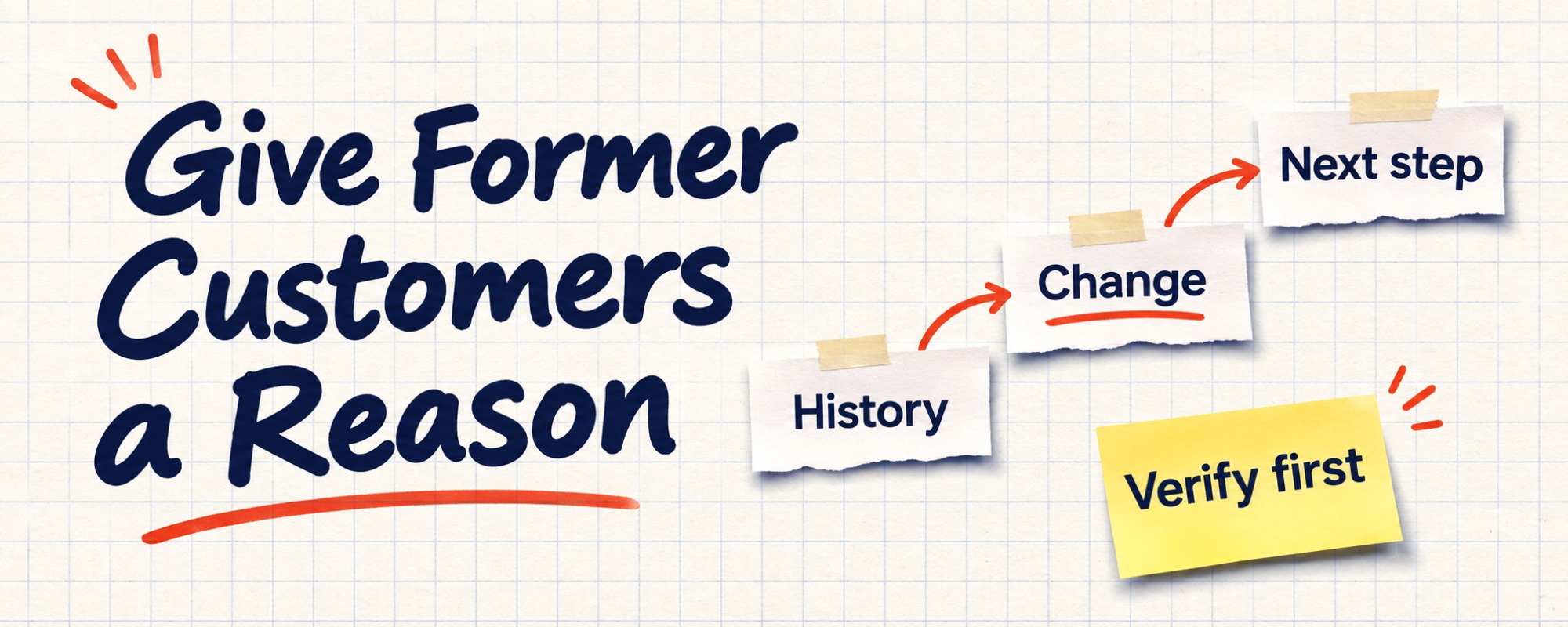
- Change: a verified product improvement, new customer need or relevant purchasing occasion.
- Relevance: how the change addresses the previous obstacle or current work.
- Recipient: a current contact with a relevant role and a valid reason to receive the message.
- Next step: the smallest useful action, such as inspecting an example or confirming a requirement.
- Stop condition: a refusal, obsolete contact, resolved request or another recorded reason to stop.
Keep fact and inference separate. A new release is a fact; that release solving the former customer’s problem is a hypothesis until its scope matches. If the departure reason is unknown, do not manufacture one from low usage or a guessed budget issue.
Respect recorded contact preferences and exclusions. A former purchase does not justify ignoring a request to stop. This workflow selects relevant conversations; it does not determine legal permission to send.
2. Match the message to what changed
Brevo’s winback documentation suggests acknowledging the previous relationship and personalizing around earlier purchases or industry. For a B2B account, make that context specific enough for the recipient to recognize.
A useful first message contains four things: the past work, the verified change, its relevant limit and one proposed next step. Avoid an account history recap or a list of every feature released since departure.
The following examples are fictional. Their product changes and customer situations are invented to explain the writing method, not offered as real company evidence.
Example A: a previous product gap has changed
Subject: Your regional reporting requirement
Hi Morgan,
When your team ended the reporting service, separate regional approval was still a requirement we could not meet. The current version now supports a regional review step; the attached example shows its scope and the remaining limits.
If regional approval is still relevant, would you like to compare that example with your current process?
Alex
The message names the old obstacle and gives the recipient a way to inspect the change. In real use, verify the capability, attach the actual example and state the important limitation. Do not write “we fixed everything” when only one part changed.
Example B: a completed project may have a new edition
Subject: Another supplier review this year?
Hi Taylor,
We worked together on the supplier review that closed last year. You mentioned that the team might repeat the exercise when the next region opened.
Is another review now planned? If so, I can send a short outline based on the scope you need today.
Alex
This is appropriate only when the earlier conversation is recorded and a relevant review point exists. It checks whether the occasion is real instead of presenting a presumed project as a fact. A completed engagement is not necessarily evidence of dissatisfaction or churn.
Example C: the reason is missing
Subject: A question about the reporting service
Hi Jordan,
We previously supported your reporting workflow. Our account record confirms that the service ended, but it does not explain which need remained unresolved.
If you are willing to share, what would a future service need to do differently to be worth considering?
Alex
Here the purpose is learning, not selling a supposedly relevant fix. Do not ask the customer to repeat a reason your team already holds. Brevo makes that distinction in its guidance on tailoring feedback requests. If the context does not support a useful contact, keep the account out of the campaign.
3. Use an offer only when it addresses the obstacle
A discount changes the price. It does not demonstrate that a missing workflow, poor implementation or unsuitable scope has improved. Review the actual obstacle before proposing an incentive.
If a scoped restart is appropriate, explain what it includes, what remains excluded and how the customer can evaluate it. Keep any commercial offer real and approved. Avoid a countdown, scarcity claim or special price invented to make the email more persuasive.
Do not assume that the old contact still owns the work or that the previous agreement can simply resume. A return may require a new scope review and customer onboarding. The email opens that conversation; it does not authorize billing or reactivate a service by itself.
4. Let the response change the plan
When someone replies, pause the generic follow-up and assign an owner. Record whether they want an example, have a different requirement, name a later review point or decline. Each response needs its own next action.
Without a response, use a bounded plan chosen for the account. Another message should add a useful clarification or close the loop. There is no universal sequence length or delay that makes a former customer ready to return. Silence is neither a buying signal nor permission to keep escalating an offer.
5. Measure return separately from email engagement
Keep a simple progression: accounts selected, messages sent, delivery observed where available, relevant replies, agreed evaluation, new paid relationship effective. Preserve the original selected group so a campaign report cannot improve merely by dropping the people who did not return.
An open is not a purchase. A positive reply is not an accepted commercial scope. State what counts as a return, the observation window and which accounts remain unresolved. Revenue should come from the actual new purchase record, not a forecast attached to a reply.
Use churn analysis to examine patterns across departures. For the individual email, keep one standard: the former customer can recognize the past relationship, understand what changed and decide on a proportionate next step.
Explore Lead Scorer for your B2B prospecting work. Keep winback drafts grounded in the customer history and verified changes your team can stand behind.